The Business Benefits of Switching to Audit Analytics Software
Moving beyond spreadsheets is about more than improving efficiency. Organizations that adopt audit analytics software gain deeper insight, stronger governance, broader risk coverage, and more reliable assurance while positioning audit, risk, and compliance teams for the future.

Why Switch?
Audit Expectations Have Changed. Spreadsheets Haven't.
Audit, compliance, finance, and healthcare assurance teams face growing data volumes, increasing regulatory scrutiny, and rising expectations from leadership.
Spreadsheets were never designed to support modern assurance programs. Purpose-built audit analytics software helps organizations analyze more data, identify risks sooner, strengthen controls, and deliver more reliable insights with greater efficiency.
Why Organizations Are Moving Beyond Spreadsheets
Most audit teams don't outgrow spreadsheets overnight. The challenge emerges gradually:-
More transactions to review
-
More systems producing data
-
More regulatory requirements
-
More stakeholders requesting assurance
-
More pressure to identify risks earlier
Audit teams don't invest in analytics simply to replace spreadsheets.
From Audit Efficiency to Enterprise Intelligence
Audit analytics maturity is a journey. Most organizations begin by using analytics to automate routine testing and improve audit efficiency. As capabilities mature, analytics evolves into a strategic asset that provides deeper risk visibility, supports continuous monitoring, and strengthens governance across the organization.
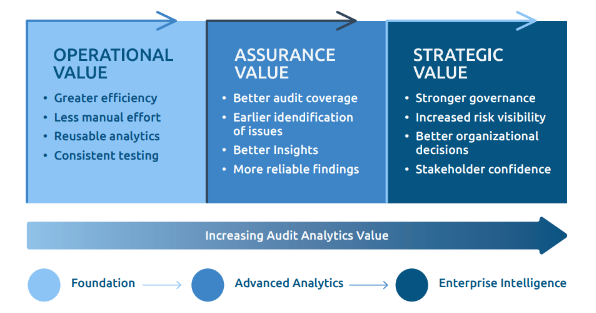
'This progression illustrates how organizations can move beyond spreadsheets and basic data analysis to unlock greater business value from their audit analytics investments. The further organizations advance along the analytics maturity curve, the greater their ability to proactively manage risk, strengthen governance, and provide data-driven insights that support strategic decision-making.'
Foundation: Analytics for Efficiency and Assurance
-
Automate routine testing
-
Increase audit efficiency
-
Improve data coverage and quality
-
Strengthen assurance
Advanced Analytics: Deeper Risk Insight and Visibility
-
Identify and monitor key risks
-
Leverage predictive and diagnostic analytics
-
Increase risk visibility across the organization
-
Enable continuous monitoring
Enterprise Intelligence: Greater Governance and Strategic Impact
-
Strengthen governance and internal controls
-
Increase stakeholder confidence
-
Support better decision-making across Audit, Risk, Compliance, and Business functions
-
Drive long-term organizational value
Key Benefits of Moving Beyond Spreadsheets
Increase Audit Efficiency and Productivity
Business Impact: Reduce manual audit procedures, Accelerate audit execution, Increase auditor productivity, Spend more time on analysis and insight generation
More Consistent and Repeatable Audit Procedures
Business Impact: Standardize audit execution, Improve audit quality and consistency, Reduce dependency on individual spreadsheet expertise, Support compliance with internal audit methodologies
Analyze More Transactions. Uncover More Risk.
Business Impact: Increase audit coverage, Gain deeper visibility into business processes, Identify issues hidden within large datasets, Strengthen audit assurance through comprehensive testing
Strengthen Risk Detection and Control Monitoring
Business Impact: Detect issues earlier, Improve fraud and error detection, Prioritize high-risk areas, Enable more proactive risk management
Stronger Governance and Stakeholder Confidence
Business Impact: Strengthen organizational governance, Enhance audit credibility, Improve confidence in audit findings, Provide greater assurance to stakeholders
Turn Data Into Actionable Insight
Business Impact: Deliver actionable business insights, Support strategic decision-making, Improve operational performance, Enable a more proactive approach to risk and governance
Unlock More Value from Every Audit
Move beyond manual processes and limited visibility. See how audit analytics can help your team improve audit quality, expand risk coverage, and deliver more strategic insight across the organization.
Why Switch?
Frequently Asked Questions About Audit Analytics Software
What is audit analytics software?
Audit analytics software allows auditors to automate data analysis, test entire populations of transactions, identify anomalies, and evaluate controls more efficiently than spreadsheets.
Why do organizations use audit analytics software?
Organizations use audit analytics software to improve audit efficiency, expand audit coverage, strengthen risk management, and provide more reliable assurance to stakeholders.
Can audit analytics replace spreadsheets?
Audit analytics software is not intended to replace spreadsheets entirely. Instead, it provides purpose-built capabilities for audit testing, continuous monitoring, data validation, and exception detection that are difficult to perform efficiently in spreadsheets.
How does audit analytics improve risk management?
Audit analytics helps organizations identify exceptions, unusual transactions, control failures, and emerging risks earlier by continuously analyzing large volumes of data.
What is the biggest benefit of audit analytics software?
One of the biggest benefits is the ability to analyze 100% of available data instead of small samples, improving both assurance quality and risk visibility.